
In Part 1 of this analysis, we addressed the implications of US tariffs, the Indian response, and its inability to open up agriculture and dairy to the USA. We also examined the collapse of the QUAD, the dynamics of India-Russian trade, and how tariffs and a tariff-hostile USA were pushing India into China’s arms. In this part, we address mediation in Indo-Pak issues, the betrayal of India, and how the US can restore the India-US trust quotient.
India Denies Mediation
On May 10th, President Trump surprised the world: “After a long night of talks mediated by the United States, I am pleased to announce that India and Pakistan have agreed to a full and immediate ceasefire,” Trump wrote on his Truth Social platform. This came barely days after Vice President Vance had said that the US was not involved in the matter.
In later days, President Trump began narrating how he allegedly brought India and Pakistan to the table in return for trade deals. To the world at large, it would imply that (a) India had accepted third-party mediation and (b) that India was ready to make concessions in its Pakistan relations in return for trade.
President Trump repeated this claim on more than 20 occasions at a time when Indian members of Parliament (government and Opposition leaders) were traveling the world explaining to world leaders what India’s stand was and its new military doctrine against acts of cross-border terror. I was fortunate to attend one such event at the National Press Club in Washington, DC. The same delegation, led by veteran Parliamentarian Shashi Tharoor, even met with US Vice President J.D. Vance and explained the situation to him.
The US thinkers need to understand Indian realpolitik. For any Indian politician to even dream of any such mediation on Kashmir would be suicide for any Indian government, let alone a BJP-led right-wing majority government, that was facing a heated parliamentary debate on Operation Sindoor.
While Pakistan quite obviously rushed its top brass to Washington to nominate POTUS for the Nobel Peace Prize and thank him for his intervention, India began clearing the air and denying the story. It was Pakistan, after all, that had run seeking US help when India decimated their entire air defense systems and 11 airstrips and brought down 6 of its fighter aircraft.
What began as routine denials at the lower levels of the Indian military soon turned into ministerial denials, culminating in the Indian Prime Minister himself denying in Parliament that any such thing had happened, with the foreign ministry even sharing details of the calls with top US officials.
In fact, India released readouts of the phone call and discussions, and the goings on, and it became clearer and clearer.
G7, the June 17th Call, and the Great Betrayal
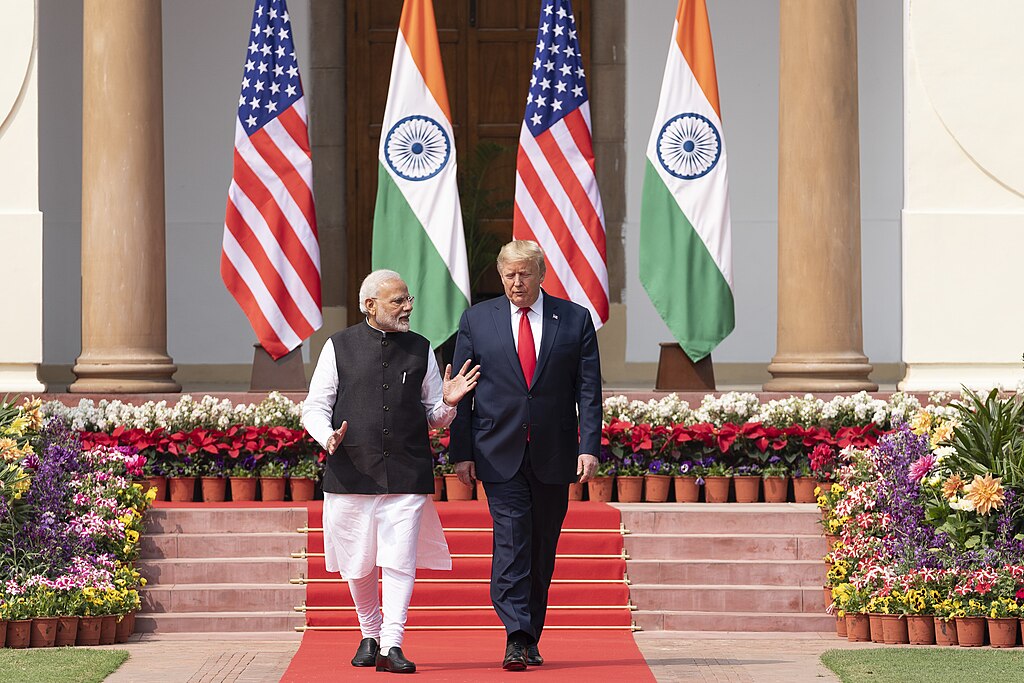
The personal closeness that Modi and Trump have shared over the last 9 years has been the stuff of legends, embracing each other at public events from the Howdy Modi to Namaste Trump, with P.M. Modi even reaching out to former President Trump when he was out of power. Short of endorsing a Trump return last June, Modi clearly wore his heart on his sleeve.
After India having publicly denied the US version of intervention in the India-Pakistan conflict, it left the US officials somewhat red-faced and unable to explain the strong rebuttal by India.
By the time the G7 met in Kananaskis, Canada, this year, the relationship had developed minor cracks in the trust quotient. Trump and Modi were scheduled to meet on the sidelines of the G7, but Trump had to rush back to DC after the first day. However, POTUS invited Modi for discussions at the White House on his way back from Canada to India.
Modi politely declined the invitation on the phone, as he had a pressing religious event in Orissa.
However, it so transpired that the Pakistani Army chief Field Marshall Asim Munir was also invited to the White House the same day. Analysts speculate that there was perhaps an attempt by the White House for a joint photo opportunity with both India and Pakistan. This situation was wholly untenable for the Indian side, and fortunately, it was avoided from escalating into a diplomatic incident.
The US went on to fete Asim Munir, and the US Army generals even publicly stated in congressional hearings that “Pakistan was an important and necessary ally”. This despite the US having accepted all the evidence on “Pahalgam terror attacks” being aided and abetted by the Pakistanis and the ISI. This led to disillusionment among the Indian side that the US was switching horses mid-race. All this was possibly due to the USA’s need to use Pakistan, as Israel overpowered Iran, or the strategic requirements in the Persian Gulf, and for some level of counterterrorism operations against Pakistani homegrown terrorists.
The official readout of that 35-minute phone call on June 17th between President Trump and Prime Minister Modi talks of discussions on productivity, shared interests, Iran, Israel, and India’s strong and firm answer to terrorism, establishing its new doctrine against terrorism.
However, Bloomberg has reported that the ties between the two friends began to crumble the moment that Indian PM Modi told the US President Trump in no uncertain terms, that there was no discussion at any level of an India-US deal for ceasefire, or any proposal for a US based Mediation to resolve the crisis between India and Pakistan and that was India’s strong position.
Modi made it clear that the two nations themselves had discussed a ceasefire, as the Pakistani DGMO had requested one from the Indian DGMO. This call between POTUS and Modi took place the day after Modi was invited to stop over in Washington.
The entire relationship pivoted post that call, and Trump issued orders for a 25% tariff on India and then went on in the most intemperate language to call “India a tariff king” and an abuser, and that “India was a dead economy”, which the USA had no interest in.
The Dead Economy
India, as one of the fastest growing economies in the world in 2024/25, is by no stretch of imagination a dead economy. India is the 4th largest economy in the world and will overtake Germany to become the 3rd largest in the next few years. It is also the world’s 3rd largest aviation market and the 4th largest military nation in the world. Thus, the outburst by the President was not worthy of a rebuttal by India.
The Indian side, however, rebutted the claim that India had the highest tariffs in the world, explaining that in some cases, such as pharmaceuticals, machinery, aircraft parts, and coal, India imposes zero to low duties on key US imports, excluding agriculture and dairy.
The President’s outbursts belied the rationale as to why the USA wanted lower tariffs and breaching agricultural barriers in India when it was a dead economy. Furthermore, if the ceasefire had been brought about with the alleged promise of enhanced trade, then where was it? Why enhanced tariffs after the ceasefire? Sadly, the US administration has become a bundle of contradictions in recent times, falling over its own previous statements, unlike previous US administrations.
While India has indicated that it wants to finalize a trade deal with its biggest trading partner, the USA, there is a red line in the sand on agriculture, fish, and dairy. India is a consumption-driven economy, with 63 percent of its GDP consumed domestically, making it one of the top 7 consumption economies in the world, boasting a market of 1.5 billion people. Its export trade with its largest partner, the USA, is barely 2.2 percent of its GDP, and although India does look to enhance it exponentially, it cannot and will not do so at the cost of its sovereign national policies.
India has dealt with tariffs and even with sanctions in the past, and the image of Indira Gandhi facing Nixon and Kissinger post the 1971 war is legendary across India. India’s economy has survived the brunt of a US economic attack when it was a poor, starving nation in 1972, and post Pokharan-1 Nuclear blasts, it will be able to weather this storm. Though a friendly resolution of trade is desirable, it is not imperative for India to surrender its independent sovereign capital.
India Doesn’t Accept Mediation
The US Special Advisor for South Asia, Ricky Gill, recently visited Delhi for the India-Middle East Economic Corridor conference (IMEC), which was finalized on the sidelines of the G-7 summit. The Washington Post reported that over an informal dinner, Gill said he understood India being upset over tariffs, but Gill was perplexed as to why India had taken the US mediation theme of the “India-Pakistan Operation Sindoor conflict” so harshly. “How does it matter who intervened?”
If this is true, then it betrays a complete lack of appreciation of India’s long-standing positions on mediation. Like Agriculture & Dairy, Pakistan & Kashmir, external mediation in any dispute form the Holy Grail for Indian polity, the untouchable taboo subjects. No Government worth its salt since the days post-Nehru could ever accept or concede an inch on any of these issues.
Trump himself is on record on various video interviews whilst on the Presidential campaign trail on 2024, talking about Modi and Pakistan and his previous offers of mediation to resolve the Kashmir issue, and Modi’s “Strong and instant response” to Trump that he would never allow anyone to intercede in India’s bilateral matters, since he knew exactly how to deal with it.
It is thus a fairy tale to suggest that the ceasefire was brought about by dangling trade deals in return for peace, and that has become part of the overall fiction in this episode.
For those uninitiated in sub-continental history, the taboo of mediation or third-party intervention historically dates back to the first Kashmir war of 1947/48. Pamela Hicks, the daughter of the Mountbatten’s, writes in her book, “India remembered”, that under the influence of Lady Edwina Mountbatten & Lord Mountbatten, India’s first Prime minister, Jawaharlal Nehru submitted the Jammu and Kashmir dispute for third party mediation to the United Nations, much against the wishes of Sardar Patel in his cabinet.
The UN, in turn, ordered a plebiscite to be held to determine the will of the people, as per Security Council Resolution 47, despite evidence that Raja Hari Singh, the King of Jammu and Kashmir and Ladakh, had legally ceded the territory to the Indian sovereign nation. Since then, India has avoided all third-party intervention or mediation, except for the Tashkent Declaration of 1965.
Recognizing Pakistan Terror and Hyphenating India and Pakistan
The US recognized that the TRF supported by Pakistan’s ISI was behind the 22nd April Pahalgam terror attacks, where 26 innocent civilians had been murdered. The TRF, which had itself claimed responsibility for the attacks, twice in the 24 hours after the attack, is an offshoot of the banned Lashkar-e-Tayba, which has its headquarters in Pakistan, like the dreaded Jaish-e-Mohammed. India launched Operation Sindoor to take out the terrorist camps, and Pakistan hit back, and India retaliated strongly; eventually, the operations ceased.
The US, knowing full well Pakistan’s role in this dreaded attack, chose to pay lip service to India’s rage and yet backed Pakistan, inviting General Munir to the White House. The US then compounded that mistake by hyphenating India with Pakistan, which may seem in the course of ordinary business in the USA; however, for India, it was a cardinal sin that caused India to seriously doubt the USA’s intentions.
The USA went one step further, and the Commander of the United States Central Command (CENTCOM) General Michael Kurrilla testified before the United States Senate foreign affairs committee that Pakistan was a most valuable and necessary ally in the war on terror, despite having a selective standard when it came to which terrorism it dealt with.
This was despite committee members referring to Pakistan as the mother lode of terrorism. General Kurilla called Pakistan a “phenomenal partner in the counterterrorism world.”
He affirmed that “We have to have a relationship with Pakistan and India, I do not believe it is a binary switch we can throw, we should look at both relationships for the positive they have.” (General Kurilla’s closing remarks to the committee.)
Thus, the American policy of running with the hares and hunting with the hounds with respect to India and Pakistan is another conundrum that needs to be analyzed and assessed by India in its own interests.
Repairing The Broken Trust
The trust has been broken, without a doubt, and the US actions have risked a relationship built over decades, over some petty trade issues. It is for the USA to analyse whether breaking off engagement with India, serves its purpose, and allowing for a future alignment between the two most populous nations of the world- India and China, or the even more scary proposition, of an alignment between the Second, third and fourth largest armies of the world on the borders of Europe and Pacific?
The situation is not irretrievable, but the glue that held US-India relations together was Trump and Modi’s personal relationship, and it will be up to them to restore the balance between the world’s two largest democracies.
The current Russia-Ukraine peace talks may overshadow it, but the Indian side will bide its time, knowing full well that Russia and India have an unbreakable bond. Once Ukraine is resolved, and the Nobel Peace Prize is in Trump’s bag, trade with India will feature again, either in this administration or the next.
China, in the meantime, is watching the situation with bated breath, as it awaits the unbanning of over 200 ventures and apps by India, and for India to clear the numerous FDI investment approvals that have been pending since 2023
Given the intemperate comments in the past, it may be up to POTUS to get on a call with Modi and bridge the gap that has appeared. It is not insurmountable, but it will require courage, the kind of courage exemplified by a Nobel Peace Prize aspirant.

Sanjay Lazar
Sanjay Lazar is an aviation analyst, Lawyer, and author who writes on International relations, Aviation, and law. He has spent 40 years in aviation and lost his entire family in the Air India Kanishka bombing in 1985. He is @sjlazars on @x.