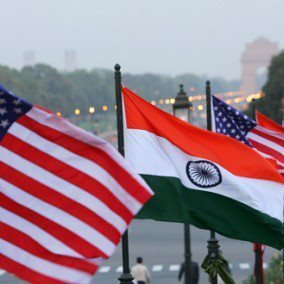
As America recalibrates its stand with India over trade, the Indian Prime Minister Modi’s speech from the ramparts of the Red Fort, on 15th August, India’s 79th Independence Day, brought into focus how global equations may be shifting and how steely India’s resolve has become, as a new geopolitical reality is emerging in South Asia.
In this two-part analysis, we study and understand what, why, and how the USA-India relationship plummeted from its bonhomie highs of “Namaste Trump and Howdy-Modi” rallies and Modi’s February 2025 visit, to where it stands today, six months later, post-operation Sindoor, tattered and on the brink of destruction, turning into gravel.
US Tariffs are Not About Oil Alone
The Indian and US trade representatives had, over the last few months, completed almost five rounds of discussions on the US-India trade deal, and both sides had reached a broad consensus on what was the best that either side could have done, under the circumstances. The sixth round, to wrap things up, was slated to be held in August after POTUS had gone through the fine print.
That, however, was not to be. The advisors to the President, and POTUS himself, felt that perhaps they could squeeze India for that bit more, and push harder, not yet having lived down the embarrassment of India’s rather public rejection of the US claim “that the US brokered the ceasefire between India and Pakistan”.
The ostensible reason for the additional tariffs of “India buying Russian oil”, was as hollow as the claims of sighting the Loch Ness Monster, which as on writing this article have shot up to 25 percent plus an additional tariff of 25 percent on selected goods into the USA, with threats of additional secondary sanctions, should the 15th August should the Trump-Putin summit go south.
The Trump-Putin talks have gone well, and for now, no further sanctions are forthcoming. As of going to print, the US trade negotiators have cancelled their visit to India.
The fact of the matter is that India has refused to bend to the US’s demands, especially regarding access to agriculture and dairy, which has irked the Trump administration. Additionally, the US’s claims of mediation in the crisis between India and Pakistan have also been rebuked.
Independent India
Modi’s Independence Day speech from the ramparts of the Red Fort emphasizes a stronger, self-reliant India, and it must not be taken lightly. It indicates that India will not bend to anyone in the world and sends a strong signal to the West. Modi’s assertions that he would “stand by our farmers and fisherman” was a tacit acknowledgment that India would not relax barriers in agriculture, dairy, and fishing —the holy grail for the USA. It was barely a week ago that Modi stated at a rally that “he would stand by the farmers and fishermen of India, even at a personal cost,” implying that his stance would not change, even if it meant a personal threat to him, his life, or his government. His NDA government has held that stance firmly.
Truth be told, the USA has failed to see, that no Indian government on either side of the Indian political spectrum could ever relax entry barriers in agriculture and dairy, because of the massive amount of farmer capital across the nation, which engages more than 54 percent of the workforce in India, though it represents only about 17 percent of the GDP, the sheer mass of people translates into a massive vote bank, and mass movements of half the nation. To upset them would destabilize any Indian government of the day, as India saw during the farm protests a few years ago, which ironically had tacit support from farm lobbies in Canada, the UK, and the USA.
The fact that US advisors did not understand this aspect or India’s mediation conundrum itself indicates how ill-prepared they have been in understanding the Indian political psyche, despite decades of overt and covert study into India, its people, and its geopolitical strategy.
Pushing India Into China’s Arms
The recent speedbumps in the India-USA trade relationship have unraveled a geopolitical nightmare scenario for the USA and NATO, which even the sharpest US hawk may not have imagined a few months ago. In a matter of weeks, India began warming up to China and Russia, with an exchange of high-level meetings and scheduled visits, including a visit to China after a seven-year hiatus, despite the Doklam hostilities and the ban on all Chinese companies in India a few years ago.
The US hawks had misunderstood entirely and miscalculated the overall impact of their machinations, or perhaps this US administration has, in its first six months, reversed the last 40 years of US Policy of global domination through strategic Asian alliances against China and Russia, in return for a Domestic’ America First’ financial policy.
Over the last few months, Indo-China relations have been experiencing a gradual but slow thaw, with confidence-building measures coming slowly but surely. However, Trump’s exceptional tariffs against India, putting it on par with China and Brazil, have led India to inch closer towards China.
India’s warming up to China has almost put paid to the “QUAD,” a Pacific-Indian Ocean grouping of Japan, Australia, India, and the USA, formed to counter Chinese hegemony in the Indo-Pacific theater. The idea was first mooted by Shinzo Abe decades ago, later revived and pursued by President Donald Trump in his first term, and subsequently built upon by President Biden.
During the next 40 days, India will host the Chinese Foreign Minister Wang Yi in Delhi, PM Modi will visit Japan, and then Prime Minister Modi will visit China for the Shanghai Cooperation Organization (SCO) meeting, followed by a visit by President Putin to India. It is widely expected that Modi and Xi Jinping will announce the reopening of air routes and flights between India and China, following a five-year ban since 2020, when the Doklam crisis erupted.
China has this week ended ‘anti-dumping duty’ on Indian halogenated butyl rubber, whilst retaining it for Canada and Japan. China has also relaxed Urea export curbs to India for its agricultural industry, which is massive. The Government of India is to consider applications by OnePlus and Xiaomi to set up additional investments in India. India’s Nayara Energy, an Indo-Russian joint venture, has also exported its first shipment of ultra-low Sulfur diesel to China, the first since 2021, despite EU sanctions, as the refinery struggles to secure raw materials from Russia. What is significant is that cargo left the Vadinar terminal for Malaysia just hours before the EU announced sanctions on the refinery, and then changed its destination to China.
This signals a sea change in the Indo-China dialogue, which was hastened only by the US’s double speak on Pakistan and escalated by the trade tariffs. All of this has happened within an extremely short window since the June 17th phone call and resultant acrimony.
Tariffs Don’t Reduce India’s Buying of Russian Oil
It seems evident that President Trump is not receiving the most accurate briefing on the situation. India, which had slowed its Russian oil purchases in May and June 2025, preceding the tariff announcement, has now actually increased its purchases of Russian oil as a hedge against the rising dollar-to-rupee rate.
The Economic Times reports that India’s purchase of Russian oil rose to 2 million barrels per day in August, up from 1.6 million barrels per day in July, and approximately 38 percent of India’s 5.2 million barrels per day of imported crude came from Russia, according to statistics from real-time data analytics provider Kpler.
This could be indicative of two things: firstly, that India is stocking up before the higher tariffs come into force, or alternatively, that India is not concerned, as they have factored in secondary tariffs or even a worst-case scenario of sanctions.
In either case, India has called out the USA’s inequitable and unjust tariff regime on the world’s largest democracy, and has clearly set out that it will not accept it. India has faced worse challenges in 1962, 1971, 1991, and 1998, and has even dealt with US sanctions, so it appears well-prepared for it.
Double Standards
Whilst the American explanation rings hollow, because China imports more Russian oil than India yet has escaped Trump’s wrath, VP Vance was hard put to explain it. Germany imports 26 percent of its LPG gas requirements from Russia, down from 55 percent in 2020. France is the largest EU importer of Russian fossil fuels, having imported $377 million in January 2025 alone. The top five buyers of Russian crude currently are China, India, the EU, and Turkey, and yet none of the others suffer the ignominy that has been imposed on India, the world’s fourth-largest economy.
The USA itself continues to trade with Russia, purchasing strategic materials such as fertilizers, palladium, and uranium, which are crucial for industries like nuclear power and the automotive sector. In fact, President Putin at the Alaska summit today even admitted that trade with the USA had increased by 20 percent after President Trump took office, thus refuting Trump’s claims about punishing Russia. The European Union imported $41.9 billion worth of goods in 2024, as per Eurostat data.
The Russia-Ukraine conflict that began in 2014 escalated into a full-fledged war in 2022. The irony of the situation is that the West has conveniently forgotten that, back in February 2022, India imported barely 2 percent of its oil from Russia. It was the USA that encouraged India to ramp up purchases, as other NATO nations pulled back due to sanctions. This was done to ensure that there was no spike in global oil prices due to increased demand resulting from the sanctions on Russian oil. That 2% Russian oil gradually rose to 20 percent and is currently at almost 30 percent of India’s total imports.
Interestingly, almost 40 percent of India’s processed Russian oil is sold to Western and NATO nations even today. To absorb this additional intake of Russian oil, Indian refineries also undertook corrective configurations to their oil refineries, which cost it billions of US dollars; hence, India is unlikely to change course immediately.
Thus, it is clear that the “Russian Oil” argument did not cause this relationship disruption.
The failure of the Trump administration to read the tea leaves has been completely out of character for a US bureaucracy that has hitherto been way ahead of the game in years gone by, priding itself on deep, intensive research and on-the-ground intel. This time, they have come up woefully short.
In the next part of this analysis, we will discuss the Betrayal of India, the Indian aversion to mediation, the so-called ‘dead economy’ of India, and measures to repair the broken trust and bring relations back to an even keel.

Sanjay Lazar
Sanjay Lazar is an aviation analyst, Lawyer, and author who writes on International relations, Aviation, and law. He has spent 40 years in aviation and lost his entire family in the Air India Kanishka bombing in 1985. He is @sjlazars on @x.